


Industry Solutions
AI in Manufacturing: How Artificial Intelligence Is Transforming the Factory Floor
What Is AI's Role in Manufacturing?
Artificial intelligence is transforming manufacturing by improving quality control, predictive maintenance, supply chain resilience, and production efficiency across factory floors worldwide. This shift is no longer experimental. The World Economic Forum's Global Lighthouse Network now runs to more than 200 leading plants. Each one uses digital and AI technology at scale, with measurable results.
AI in manufacturing means machine learning, computer vision, and predictive analytics applied to plant work. That covers maintenance, quality inspection, production scheduling, and supply chain risk. Rather than replacing the workforce, AI helps manufacturers catch defects earlier, reduce downtime, and respond faster to disruptions before they affect output.
Why Manufacturing Is a Strong Fit for AI
Factories produce constant data from sensors, lines, and quality checkpoints. Most of it went unused, because reviewing it by hand is slow and inconsistent. AI changes that by processing production data continuously and surfacing insights in near real time.
The Global Lighthouse Network has grown to 201 production facilities and value chains. Each is recognized for using digital and AI technology at scale. The results span productivity, supply chain resilience, talent, sustainability, and customer focus. These lighthouse factories serve as proof points for what AI can achieve when implemented well.
Why AI Adoption Is Accelerating Now
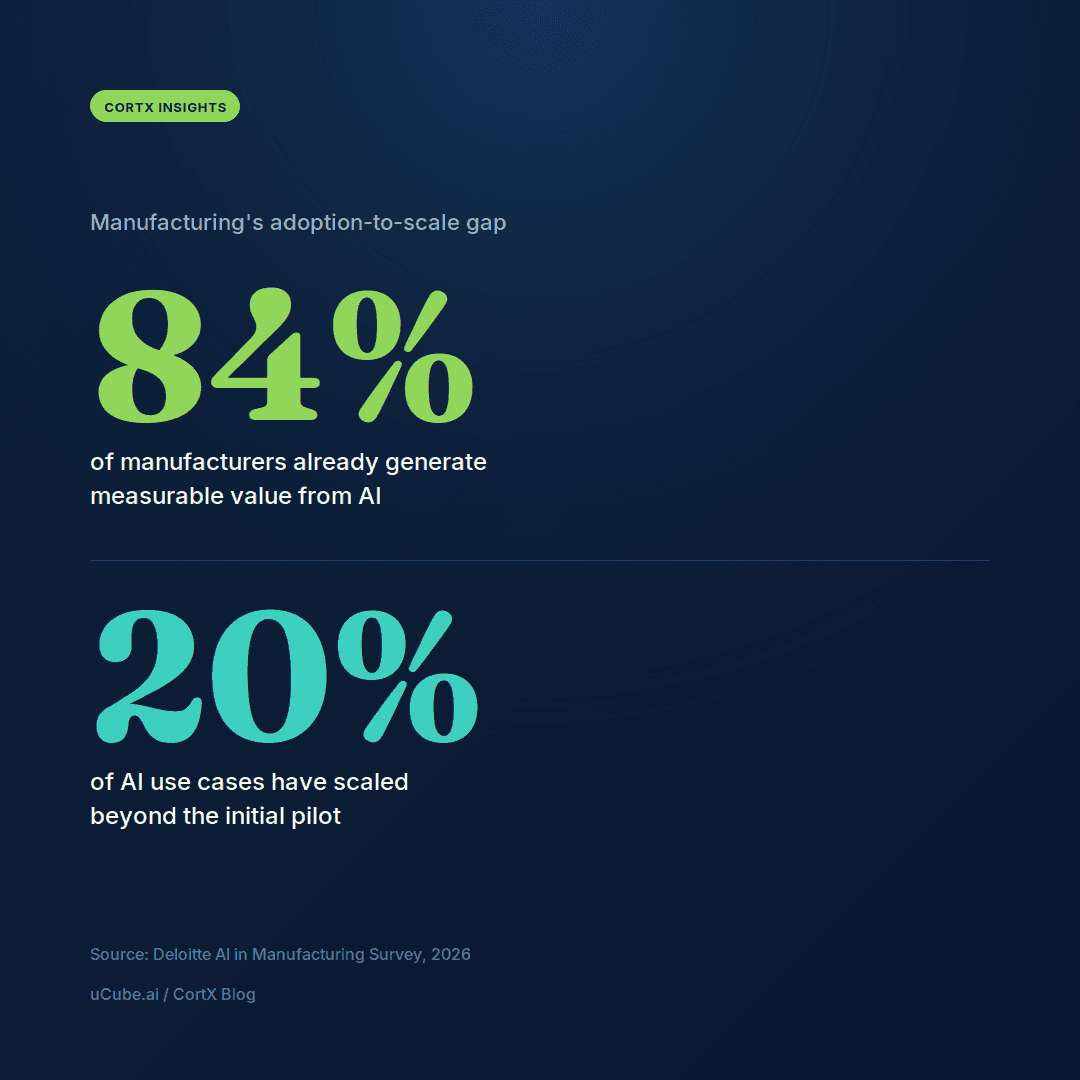
Deloitte's AI in Manufacturing Survey found 84 percent of manufacturers already getting measurable value from AI. Only 20 percent of use cases have scaled past the pilot. This gap between adoption and scaling is one of the defining challenges of the current moment.
Deloitte's 2026 Manufacturing Industry Outlook adds that 80 percent of executives plan to invest more in automation, analytics, and AI. Agentic AI is moving out of pilots and onto the floor. Deloitte also expects more than 81 percent of task hours in manufacturing to stay human-driven. AI is there to support the workforce, not replace it.
AI Use Cases in Manufacturing: A Deeper Look
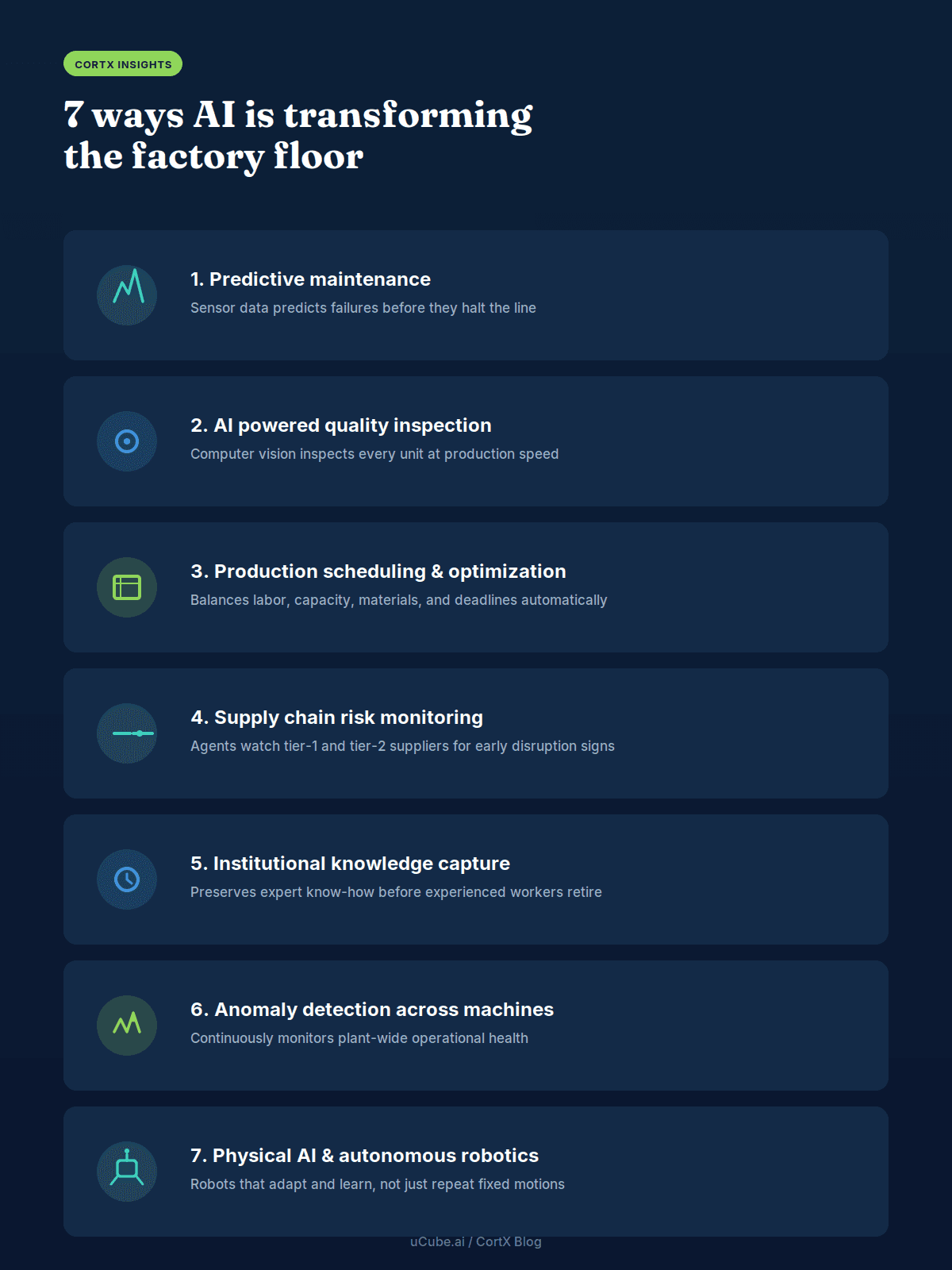
AI is already reshaping tasks across the factory floor, from equipment maintenance and quality inspection to scheduling and supply chain risk monitoring.
1. Predictive Maintenance
Unplanned equipment failure is among the costliest events on a factory floor. A single machine can stop a line and delay everything downstream. Models trained on sensor data and maintenance history predict when a machine will fail. Teams then schedule the work instead of reacting to a breakdown.
Maintenance stops being a calendar exercise and becomes data-driven. Unplanned downtime and emergency repair costs both fall. Lighthouse factories in the WEF network have used predictive maintenance as one of their core use cases for improving uptime and productivity.
2. AI Powered Quality Inspection
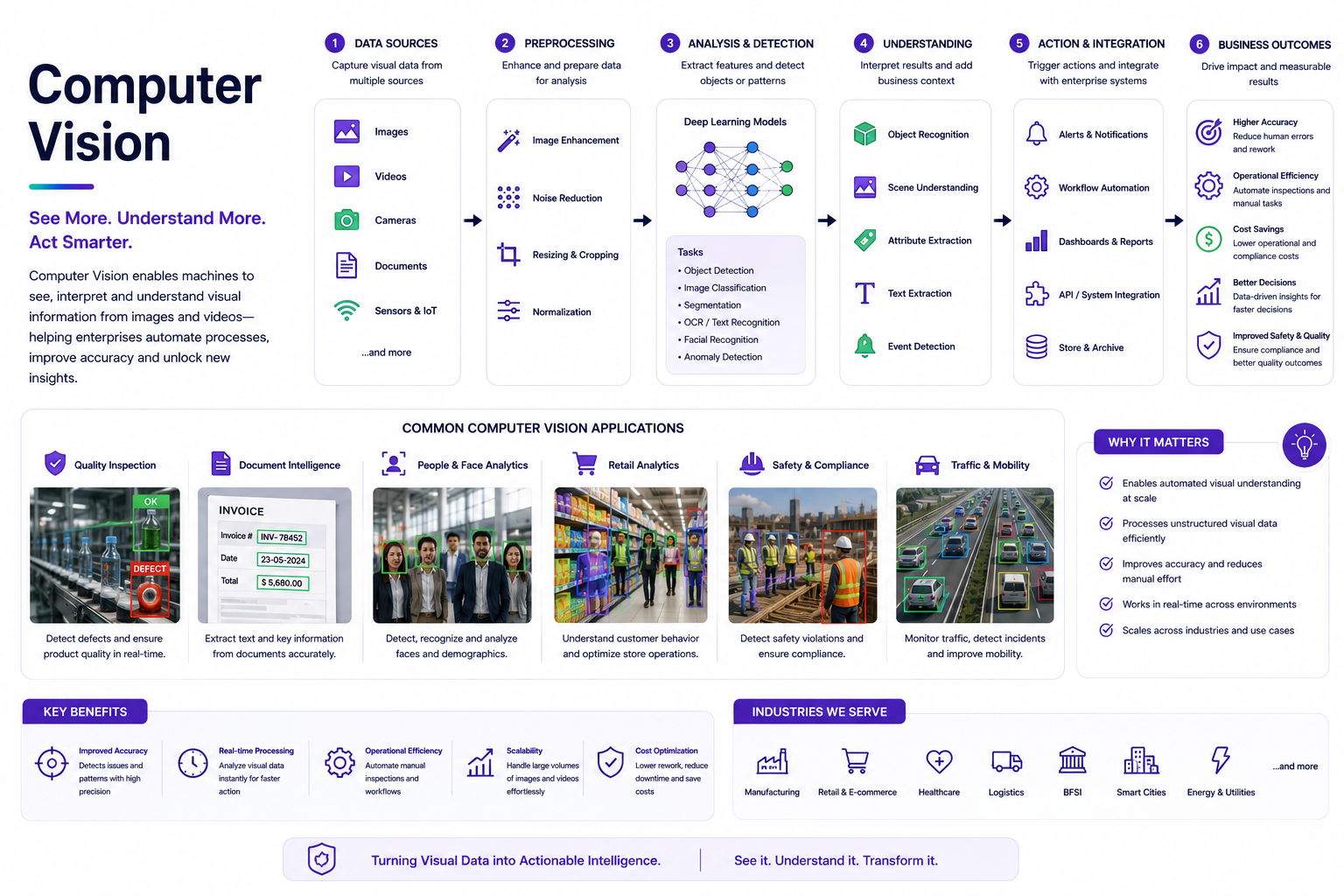
Traditional quality control leans on manual inspection or sampling. Subtle defects slip through, and neither method scales to high volume. Computer vision inspects every unit at line speed. It catches defects no human inspector could spot consistently across a full shift.
This matters most where tolerances are tight, as in electronics or automotive components. There, a small defect turns into a recall or a safety problem.
3. Production Scheduling and Line Optimization
A production schedule has to balance labor, machine capacity, material supply, and order deadlines at once. That combination is beyond manual planning at scale. AI powered scheduling tools can simulate multiple production scenarios and recommend the sequence that best balances throughput, cost, and delivery commitments.
McKinsey's work on manufacturing Lighthouses shows the value is not confined to single machines. Generative AI and advanced analytics now span whole production and supply chain processes. Functions that used to sit in silos coordinate.
4. Supply Chain Risk Monitoring
Global manufacturers face constant exposure to disruptions from trade policy changes, tariffs, weather events, and supplier instability. Deloitte's 2026 outlook describes AI agents watching for disruption across tier one and tier two suppliers. The agent drafts a mitigation plan; a human reviews and approves it.
That moves the team from crisis management to risk sensing. Supply chain staff get time to act before production feels it.
5. Institutional Knowledge Capture
Manufacturing faces a growing challenge as experienced workers retire, often taking decades of undocumented process knowledge with them. Deloitte notes AI can now capture that institutional knowledge through conversations with experts. New employees hitting the same problem can then find it.
This helps smaller manufacturers most. They rarely have formal documentation, and critical know-how has always passed down informally from long-serving staff.
6. Anomaly Detection Across Machines and Processes
Predictive maintenance no longer stops at one machine. AI agents watch data across many machines and processes at once. They flag anomalies and suggest fixes no team has the bandwidth to find by hand. This gives plant managers a broader, continuously updated view of operational health across the entire facility.
7. Physical AI and Autonomous Robotics
The next phase is physical AI. Robots and autonomous tools carry sensors and enough intelligence to adapt and learn, rather than repeat one rigid motion. Deloitte's research adds a precondition: strengthen data governance and cybersecurity first. Physical AI only works on trustworthy, well-managed data.
Challenges and Risks of AI in Manufacturing
Every credible discussion of manufacturing AI needs to address its limitations. A few risks are worth planning for before adoption.
- Scaling. This is the biggest gap. Deloitte found 84 percent of manufacturers seeing measurable value, but only 20 percent of use cases past the pilot stage.
- Data architecture. This is the other common barrier. AI agents need integrated, modern data systems, not AI bolted onto legacy plumbing.
- Workforce readiness. This also matters, since sustainable value depends on coordinated human machine collaboration rather than simply deploying tools and expecting adoption.
- Governance and cybersecurity. These must be addressed early, especially as manufacturers move toward physical AI and autonomous robotics on the factory floor.
How Manufacturers Should Approach AI Adoption
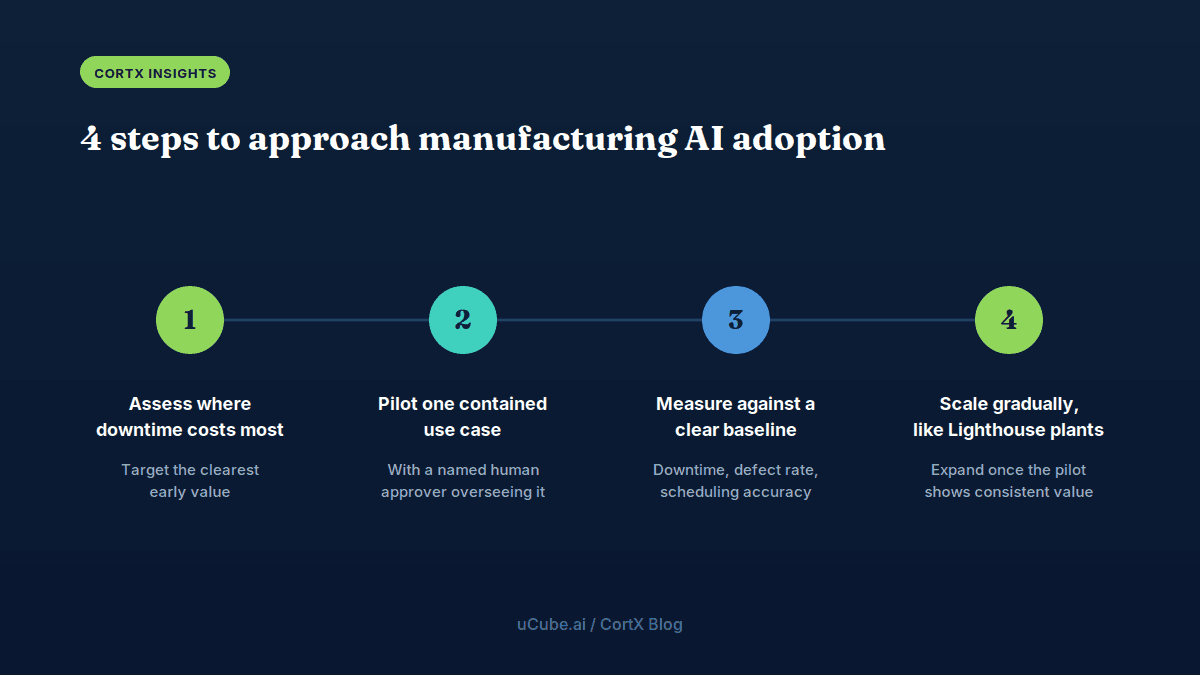
Manufacturers do not need to adopt AI across every function at once. A more effective approach follows four steps.
- Assess existing operations. Identify where disruption, downtime, or quality issues are most costly, since this is where AI can deliver the clearest early value.
- Pilot on one contained use case. Start with something like predictive maintenance or quality inspection, with a named human approver overseeing the results.
- Measure results against a clear baseline. Track downtime reduction, defect rates, or scheduling accuracy.
- Scale gradually. Expand once the pilot shows consistent value, following the pattern used by leading Lighthouse factories that started narrow and expanded over time.
What Does the Future of AI in Manufacturing Look Like?
Manufacturing is moving toward continuous data monitoring. Maintenance, quality, scheduling, and supply chain decisions all get faster and better informed. The Global Lighthouse Network shows what that looks like in practice. More than 200 facilities are already posting strong results at scale.
Deloitte expects the next wave to center on agentic and physical AI. Autonomous agents and intelligent robots will take on more complex, adaptive work alongside people. Manufacturers that build strong data foundations now will be better positioned to capture this next wave of value.
Key Takeaways
- AI is already active in predictive maintenance, quality inspection, scheduling, and supply chain risk monitoring across manufacturing.
- The World Economic Forum's Global Lighthouse Network includes over 200 facilities demonstrating AI value at scale.
- Deloitte research shows 84 percent of manufacturers see measurable AI value, though only 20 percent of use cases have scaled beyond pilots.
- AI complements rather than replaces manufacturing workers, with the majority of task hours expected to remain human driven.
- Manufacturers that pilot AI on a focused use case are better positioned to scale successfully.
Frequently Asked Questions
AI in manufacturing is primarily used for predictive maintenance, quality inspection, production scheduling, supply chain risk monitoring, and increasingly, autonomous robotics.
Computer vision systems can inspect every unit at production speed, detecting defects more consistently than manual sampling based inspection methods.
Yes. Deloitte research shows 84 percent of manufacturers already generate measurable value from AI, and the World Economic Forum's Lighthouse Network has grown to over 200 facilities.
No. Deloitte projects that more than 81 percent of manufacturing task hours will remain human driven, with AI designed to support workers rather than replace them at scale.
Scaling is the most common barrier. While most manufacturers see value from AI pilots, only a fraction have successfully scaled those use cases across their operations.
Physical AI refers to robots and autonomous tools equipped with sensors and intelligence that allow them to adapt, learn, and make real time decisions, rather than performing only fixed, repetitive motions.

Turn this insight into your next move.
Tell us what you're building and we'll show you where uCube.ai actually fits — no generic demo, just a straight conversation about your data and your goals.